

Did you know that over 70% of professional artists consider a high-quality charcoal tool to be the single most important factor for achieving deep, expressive shadows? This simple instrument holds the key to unlocking dramatic contrast and emotional depth in your work.
We understand that selecting the right tool can completely transform your creative journey. Whether you’re taking your first steps into the world of sketching or you’re a seasoned creator looking to refine your technique, the choice matters. This guide is designed to walk you through every consideration.
We will explore how these specialized instruments differ from standard graphite. You’ll learn why they are essential for creating those rich, velvety darks that make artwork pop. Our focus is on the Indian market, comparing real products and brands available to you.
Our goal is simple: to empower you with the knowledge to choose tools that inspire confidence. We combine technical expertise with practical insights for all skill levels. By the end, you’ll know exactly what makes a tool “premium” and how to find the perfect match for your vision and budget.
Key Takeaways
- A top-quality charcoal tool is crucial for achieving professional-level contrast and depth.
- The right selection can significantly impact your creative journey, regardless of your experience level.
- These specialized instruments offer unique properties distinct from graphite.
- Understanding quality indicators helps you identify truly premium products.
- This guide provides practical insights tailored for the Indian art market.
- Informed choices lead to tools that boost confidence and enhance creative expression.
- We will compare real brands and pricing to help you find the best value.
Introduction to Premium Black Charcoal Pencils
What sets premium charcoal tools apart is their unique ability to create rich, matte finishes that graphite cannot achieve. These specialized instruments combine the expressive depth of traditional charcoal with the precise control artists need for detailed work.
We appreciate how these tools represent a perfect marriage between two worlds. They offer the bold, dramatic marks of charcoal sticks while providing the clean handling of standard drawing instruments. This combination gives creators the best of both approaches.
The construction matters significantly. Premium options feature compressed charcoal cores encased in wood or paper sleeves. This design keeps hands cleaner than traditional sticks while maintaining full artistic versatility. Artists gain control without sacrificing expressive potential.
These tools excel across various creative applications. Portrait work benefits from their subtle gradations. Landscape sketching gains atmospheric depth. Experimental mixed-media pieces achieve new textural dimensions. The tonal range supports serious artistic exploration.
| Feature | Charcoal Instruments | Graphite Options |
|---|---|---|
| Black Intensity | Deep, velvety matte finish | Lighter with metallic shine |
| Blendability | Excellent smudging capacity | Moderate blending ability |
| Erasability | Forgiving for corrections | Clean removal possible |
| Artistic Applications | Dramatic works, portraits | Technical drawings, sketches |
Transitioning artists often discover new creative dimensions. The medium encourages bold mark-making while allowing refinement through blending techniques. Understanding premium quality involves examining core purity, consistency, and grading standards.
In the Indian art market, both international and domestic brands offer reliable options. Students and professionals can find quality tools at various price points. Accessibility ensures everyone can explore these versatile instruments.
Understanding the “black charcoal pencil” Quality and Performance
Quality assessment in art supplies involves testing how consistently a tool delivers reliable results across various artistic applications. We look beyond marketing claims to examine tangible characteristics that directly impact your creative workflow.
A premium drawing instrument should glide smoothly across paper without any scratchy resistance. This seamless application indicates proper processing and high-quality materials. Consistent performance from one tool to the next within the same grade is equally important.
The core density matters significantly—it should be firm enough to avoid excessive crumbling yet soft enough to release rich pigment with appropriate pressure. Quality control processes ensure uniform diameter and proper centering within the wood casing.
We find that extended use reveals true quality. Does the instrument maintain its performance throughout its entire length? Reliable brands ensure their products deliver predictable results from first stroke to last.
Understanding these markers helps distinguish genuinely premium products from those with inflated prices. Your artistic confidence grows when you know your tools will perform consistently.
The Benefits of Using Charcoal in Artwork
When creators explore charcoal as their primary medium, they unlock a spectrum of artistic possibilities unavailable with other tools. This versatile material transforms the creative process through its unique expressive capabilities.
Rich, Dark Tones and Texture
Charcoal delivers unmatched depth in dark values that graphite cannot replicate. The matte finish creates velvety blacks perfect for dramatic shading.
Artists achieve extraordinary texture variations through blending techniques. Smooth gradations bring realism to portrait work and atmospheric effects to landscape sketching.
Versatility in Artistic Expression
This medium encourages bold experimentation across different artistic styles. Its forgiving nature allows corrections while maintaining creative spontaneity.
We find charcoal ideal for quick sketching that establishes strong compositions. It integrates beautifully with other media for mixed-media applications.
| Artistic Application | Charcoal Advantage | Recommended Technique |
|---|---|---|
| Portrait Drawing | Subtle skin tone gradations | Layered shading with blending |
| Landscape Sketching | Atmospheric depth creation | Broad stroke application |
| Quick Studies | Immediate value establishment | Gesture drawing approach |
| Mixed Media | Seamless integration | Combination with white pencils |
These benefits make charcoal an enduring favorite for artists seeking expressive freedom. The medium supports both classical techniques and contemporary experimentation.
Key Features to Consider in a Charcoal Pencil
Selecting the right charcoal instrument involves more than just brand preference. It’s about matching key features to your artistic style and desired outcomes. We guide you through the most important aspects to evaluate.
Range of Pencil Grades
A versatile set offers a spectrum of hardness levels. This range is crucial for creating a full tonal scale in your artwork.
Look for a minimum of four distinct grades. A hard grade is perfect for light sketches and fine details. Softer options deliver rich, dark values for dramatic shadows. Intermediate grades handle the essential middle tones.
Clear labeling, like HB to 6B, helps you choose the correct tool predictably. This ensures consistency throughout your creative process.
Erasability and Blendability
These two properties greatly impact your control over the medium. Premium products should erase cleanly without damaging the paper.
This allows for easy corrections and highlight lifting. Superior blendability lets you create smooth gradients and soft transitions.
Some cores are powdery for effortless smudging. Others have binders for more control and less mess. Your preference will dictate the best choice for your technique.
Considering these features empowers you to build a kit that truly supports your vision. The right tools make all the difference.
Comparing Top Charcoal Pencil Brands
For artists seeking reliable performance, General’s Charcoal Pencils and Conte Pierre Noire consistently deliver exceptional results. These professional-grade brands offer distinct experiences that cater to different preferences and skill levels.
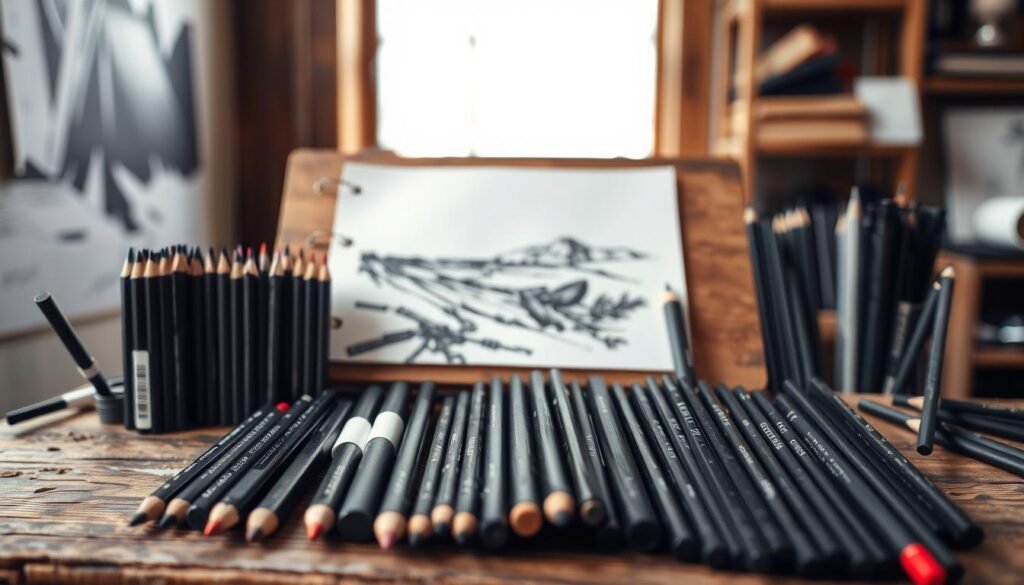
We find that understanding their core differences helps you select the perfect tool for your artwork. Let’s examine what sets these popular options apart.
General’s Charcoal Pencil: The Authentic Experience
The general charcoal pencil is pure compressed charcoal. This creates a rich, powdery application that professional artists love.
It offers excellent blendability for smooth gradients. The range includes grades from 6B to 2H for full tonal control.
This instrument works beautifully with white pencils for highlights. It provides the classic, expressive feel many creators prefer.
Conte Pierre Noire: Controlled Performance
Conte Pierre Noire tools use a likely composite formula. They convincingly mimic traditional charcoal with added control.
A slightly waxier core means less powder and reduced mess. This makes conte pierre options excellent for beginners.
Their sets typically include H, HB, B, and 2B grades. The pierre noire H grade performs similarly to a General’s HB.
| Feature | General’s | Conte Pierre Noire |
|---|---|---|
| Composition | Pure compressed charcoal | Charcoal composite |
| Texture & Mess | Powdery, authentic feel | Less messy, easier control |
| Ideal For | Professionals, experienced users | Beginners, detailed work |
| Grade Range | 2H, HB, 2B, 4B, 6B | H, HB, B, 2B |
| Blendability | Superior smoothness | Good, with more control |
Both charcoal pencils erase well and are available in India. Your choice depends on whether you prioritize authentic blendability or cleaner handling.
Evaluating Comfort and Ease of Use
How a drawing instrument feels during extended creative sessions often determines whether it becomes a trusted companion. We believe technical specifications matter less than the actual experience of using art supplies over time.
Comfort directly impacts your artistic journey and final results. The right tools should feel like natural extensions of your creative intent.
Grip, Weight, and Sharpening Efficiency
Physical dimensions vary significantly between brands. Some Charcoal Pencils maintain standard diameter while others run thicker.
Conte Pierre Noire instruments are slightly thicker than General’s options. This added thickness affects sharpening time and point precision.
The extra weight might seem minor but becomes noticeable during long sessions. Artists working on large-scale pieces particularly appreciate balanced weight distribution.
Sharpening efficiency represents a practical workflow consideration. Quality instruments should sharpen cleanly without excessive breakage.
They need to hold a reasonable point for detailed work. Constant resharpening interruptions can disrupt creative flow.
We recommend testing different brands with various techniques. Try broad shading, fine cross-hatching, and extended sketching to find your perfect match.
Grip comfort varies between wood-encased and paper-wrapped options. Each artist develops personal preferences through experience.
Ultimately, comfort remains subjective. Discovering what feels right for your hand and technique is part of artistic development.
Exploring Pencil Grading and Range
Artistic expression reaches new heights when you comprehend the strategic purpose behind each grade in your toolkit. We believe understanding this system transforms how you approach every drawing project.
The grading scale tells a clear story about performance capabilities. Higher “B” numbers indicate softer cores that deliver richer, darker marks with minimal pressure.
Soft Versus Hard Lead Options
Soft options excel at creating dramatic shadows and covering large areas efficiently. They blend beautifully and allow for bold, expressive mark-making that captures emotion.
Harder grades provide precision for detailed work and initial sketching. They maintain sharp points longer and help build values gradually without committing to dark tones too quickly.
Intermediate grades offer the perfect balance for general drawing tasks. An HB or 2B instrument becomes your go-to choice for versatile application across various techniques.
We recommend building a comprehensive set that spans the full spectrum. Having at least four distinct grades ensures you can handle lights, darks, and everything in between.
Remember that different brands may interpret grades slightly differently. Testing your specific charcoal pencil range helps you understand its unique characteristics for predictable results.
Effective Shading, Blending, and Erasing Techniques
The true magic of charcoal emerges when you master the interplay between shading, blending, and erasing—three techniques that transform simple marks into dimensional artwork. We see these skills as the foundation for creating professional-looking drawings with depth and atmosphere.
Effective shading begins with pressure control. Light touches create delicate values, while firm pressure deposits rich pigment for dramatic darks. This controlled approach builds the foundation for your entire composition.
Blending opens incredible expressive possibilities. You can use tortillons for precise work or soft brushes for broader effects. More powdery formulations like General’s blend effortlessly, creating seamless transitions.
Erasing shouldn’t just correct mistakes—it’s an active drawing technique. A kneaded eraser becomes your tool for lifting highlights and creating light passages. Shape it for precision or use broad surfaces for subtle effects.
We recommend combining these techniques in layers. Build darks, blend for smoothness, then lift lights for luminosity. This layered approach produces sophisticated results that make your artwork stand out.
Tips for Combining Charcoal with White and Graphite
Unlocking new dimensions in your artwork becomes possible when you master the art of combining different drawing media. We find that mixing these tools opens creative pathways that single-medium work cannot achieve.
For exceptional results with white highlights, the General’s Charcoal White 558 stands out. Its bright, warm tone avoids the blue tint found in some alternatives. The powdery core blends beautifully over standard charcoal marks.
Working on mid-toned paper revolutionizes your approach. You can establish both lights and darks simultaneously, sculpting form from a neutral base. This technique creates dramatic contrast efficiently.
Graphite brings a different quality to mixed-media pieces. Its slight sheen provides textural interest against the matte finish of charcoal. Use graphite for precise details and charcoal for expressive shadows.
| Combination Type | Primary Use | Key Advantage | Recommended Tool |
|---|---|---|---|
| Charcoal + White | Highlight creation on toned paper | Maximum contrast and luminosity | General’s White 558 |
| Charcoal + Graphite | Mixed-media detailing | Textural variation and precision | Standard graphite pencil |
| Layered Application | Smooth gradient creation | Seamless mid-tone transitions | Blending stump or brush |
Remember that charcoal is more forgiving than graphite when erasing. Plan your layering sequence carefully for optimal control. These techniques will elevate your drawing practice significantly.
How to Optimize Drawing Techniques with Charcoal Pencils
Elevating your creative work requires more than quality supplies—it demands strategic application methods. We believe technical mastery transforms basic sketching into compelling artistic statements that capture attention and emotion.
Understanding deliberate processes separates tentative work from professional results. Our approach focuses on building confidence through proven methods.
Layering for Depth and Contrast
Building artwork in layers creates sophisticated dimensionality. Start with light values and gradually add darker tones for complete control.
This method prevents overworking and allows adjustments throughout your creative process. Strategic contrast guides viewers’ eyes through your composition.
Hand stabilization dramatically improves precision. Anchor your hand on the paper and use your whole arm for large strokes rather than just wrist movement.
Smooth gradations can be achieved through patient, controlled pressure variation. Consistent stroke direction produces seamless value transitions that demonstrate mastery.
| Technique | Primary Application | Key Benefit | Skill Level |
|---|---|---|---|
| Layered Shading | Building dimensional forms | Precise value control | All levels |
| Hand Stabilization | Detailed work and precision | Reduced shakiness | Beginner-friendly |
| Pressure Gradation | Smooth transitions | Tool-free blending | Intermediate+ |
| Strategic Contrast | Focal point emphasis | Visual hierarchy | Advanced |
Different sketching approaches suit various subjects. Loose, gestural work captures movement while controlled techniques suit detailed rendering.
Experiment with mark-making variety to develop your unique artistic voice. Your paper surface significantly impacts how these charcoal pencils respond to different techniques.
Enhancing Your Artwork with Complementary Supplies
Achieving professional results involves more than just quality drawing tools—it requires a holistic approach to your entire creative setup. We believe the right combination of supporting materials can dramatically improve both your workflow and final artwork.
Choosing the Right Paper
Selecting the proper drawing paper is crucial for optimal performance. The surface texture directly affects how your medium interacts with the sheet.
Smooth options like Strathmore Bristol work beautifully for detailed, refined work. Textured surfaces add visual interest and help with large area coverage. Heavier weight paper (100 lb/160 gsm+) withstands pressure without buckling.
| Paper Type | Best For | Surface Texture | Recommended Weight |
|---|---|---|---|
| Smooth Bristol | Detailed work, even tones | Fine, uniform | 100-140 lb |
| Textured Drawing | Expressive marks, speed | Medium tooth | 90-120 lb |
| Heavyweight | Layered techniques | Varied options | 160+ lb |
Essential Accessories and Tools
Your creative set becomes complete with thoughtful accessory selection. These tools enhance control and preserve your work.
Blending stumps and tortillons provide precise smoothing. Soft brushes handle broader effects beautifully. Quality kneaded erasers lift pigment without damaging your drawing paper.
We recommend assembling a comprehensive set that includes fixative spray for preservation. Proper storage solutions protect your investment and maintain organization.
Insights from Real User Reviews and Brand Comparisons
Beyond manufacturer claims, user reviews offer practical wisdom about drawing tool performance. We analyze extensive feedback from Indian artists to reveal which brands truly deliver satisfaction.
BRUSTRO emerges as a best-selling option with strong 4.2-4.5 star ratings. Its accessible price point makes it ideal for students exploring this medium.
General charcoal instruments maintain consistent praise across reviews. Users note their smooth application and professional results, reflected in 4.2-4.6 star ratings.
Derwent receives favorable feedback for quality consistency. Their packaged sets often include helpful accessories, enhancing value for artists.
Staedtler Mars Lumograph stands out with 4.5-star ratings. Reviewers appreciate their controlled application and excellent erasability.
Complete drawing sets offering 28-110 pieces provide excellent value. These comprehensive kits receive 4.3-4.5 star ratings across multiple brands.
Price-to-performance ratio emerges as a common theme in feedback. Many users note that mid-range options deliver quality results without premium investment.
This page reveals that while international brands have devoted followings, domestic options earn loyalty through reliable quality at accessible prices.
Price, Value, and Quality Considerations
Smart investment in art supplies begins with understanding how pricing reflects different levels of quality and value. We help you navigate this landscape to find tools that match both your budget and creative needs.
The Indian market offers impressive range in cost. Individual instruments start around ₹58, while premium imported kits reach ₹1,117. This price spectrum represents distinct quality tiers and brand positioning.
Small sets of 3-6 pieces typically cost ₹111-₹390. Best-selling options like BRUSTRO’s 4-piece set at ₹111 provide excellent entry-level value. These are perfect for artists testing the medium.
Mid-range collections with 12-29 pieces price between ₹220-₹810. They often include essential accessories. This represents the sweet spot for serious hobbyists.
Large comprehensive charcoal pencil set options range from ₹486-₹1,419. Despite higher initial cost, they deliver exceptional long-term value. Savvy shoppers focus on absolute price rather than discount percentages.
Premium international brands command higher costs but deliver consistent performance. Your investment should align with skill level and intended use. This page helps you make strategic choices for your creative journey.
Finding the Best Premium Options in India
Today’s Indian artists enjoy unprecedented access to professional-grade drawing instruments from both global and domestic brands. The market has evolved significantly, making premium tools readily available across the country.
We find that online platforms have revolutionized shopping for art supplies. Detailed product page information helps artists compare options effectively. Fast delivery within 1-3 days is now standard, with free shipping often available on orders above ₹1,500.
International brands like General’s and Derwent coexist with popular domestic options. BRUSTRO consistently appears as a best-seller, with “1K+ bought in past month” metrics demonstrating strong local trust.
Complete drawing set options provide excellent value for artists starting their sketching journey. Brands like Corslet and Wynhard offer comprehensive kits at competitive price points.
Traditional Indian companies like Camlin have expanded into this category. Their accessible price makes them ideal for students exploring drawing sketching techniques.
Each product page now includes customer reviews and ratings. This transparency helps artists make informed decisions without visiting physical stores.
Seasonal sales and festival offers frequently reduce costs further. Timing larger purchases around these events maximizes value for serious artists.
Regional availability continues to improve nationwide. Online shopping ensures artists everywhere can access the full range of premium options.
Maintenance and Care Tips for Charcoal Pencils
Protecting your artistic investment begins with understanding how to properly maintain your drawing instruments. We believe thoughtful care practices extend the usable life of your supplies while ensuring consistent performance.
Proper Storage and Cleaning
Store your drawing tools horizontally in protective cases or pencil rolls. This prevents delicate cores from breaking due to impact or vibration. Gentle handling during transport preserves their structural integrity.
Keep these instruments separate from other art supplies to prevent cross-contamination. Charcoal dust can transfer to erasers and blending tools, compromising their effectiveness in your creative work.
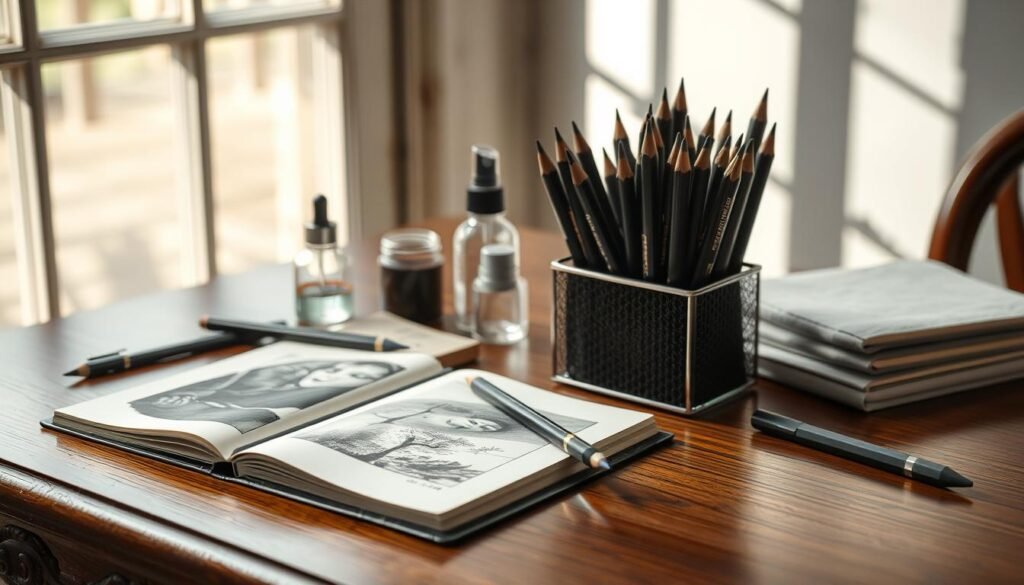
Regular cleaning maintains tool effectiveness. Refresh blending stumps by rubbing them on fine sandpaper. Dedicate specific brushes for charcoal work and clean them periodically.
Use sharpeners designed for soft drawing instruments. Their specialized blade angles accommodate delicate compositions, reducing breakage during sharpening.
| Storage Method | Advantage | Ideal For |
|---|---|---|
| Horizontal Cases | Prevents core breakage | Long-term preservation |
| Pencil Rolls | Portable protection | Travel and classes |
| Separate Compartments | Avoids contamination | Mixed media artists |
| Climate Control | Maintains consistency | Humid environments |
Wipe down instrument exteriors periodically to remove accumulated dust. This prevents unwanted smudging on your drawing surface and keeps your workspace clean.
Climate considerations matter for art supplies. Moderate, stable storage conditions protect against humidity and extreme dryness. These factors influence how materials perform.
Conclusion
Finding the perfect artistic companion involves more than just specifications—it’s about discovering tools that resonate with your personal style. We’ve equipped you with comprehensive knowledge to make informed choices for your drawing and sketching practice.
The right charcoal pencil becomes an extension of your creative vision. Whether you prefer pure formulations or controlled alternatives, your selection should inspire confidence. Technical excellence meets personal preference in this rewarding discovery process.
Your artistic journey deserves quality instruments that support growth and expression. Experiment freely, trust your instincts, and let your chosen pencils elevate your art. Every artist finds their perfect match through hands-on experience.
FAQ
What makes a premium charcoal pencil different from a standard one?
How do I choose the right grade for my artwork?
Are these drawing tools easy to erase and blend?
Can I use charcoal pencils with graphite or white charcoal?
What type of paper is best for use with these supplies?
How should I store my set to keep them in good condition?
What are the main differences between General’s and Conte Pierre Noire brands?
