
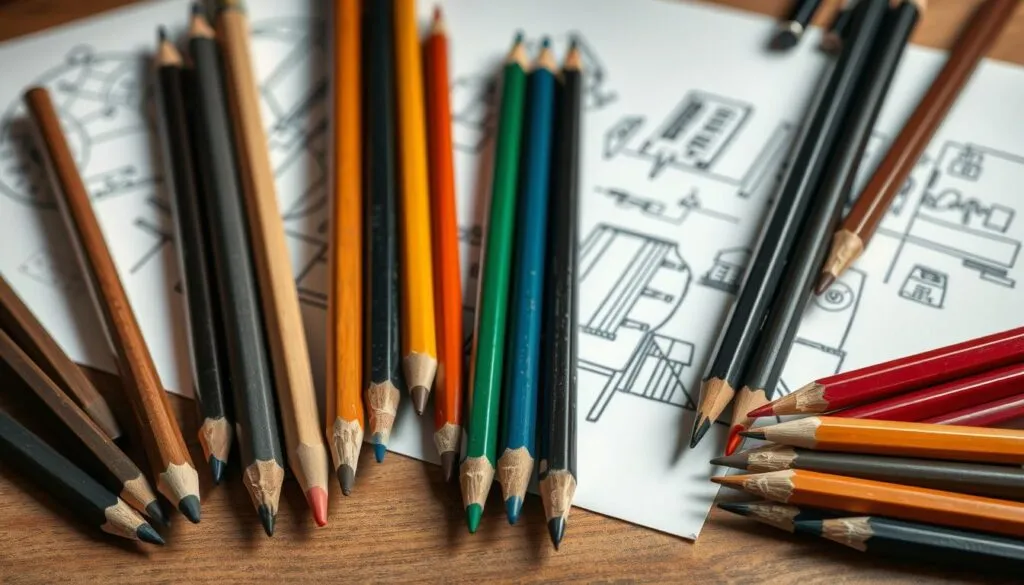
The humble pencil is perhaps the most versatile tool in any artist’s collection. Whether you’re sketching a preliminary outline, creating detailed pencil art, or working on elaborate shading techniques, selecting the right pencil can significantly impact your artistic expression. In India’s vibrant art scene, artists have access to a wide range of pencils—from traditional graphite to specialized colored variants. This guide will help you navigate the world of pencils and find the perfect match for your artistic vision.
Understanding Pencil Types

Before diving into specific recommendations, it’s essential to understand the various types of pencils available and their unique characteristics. Each type serves different artistic purposes and offers distinct advantages for various techniques and styles.
Graphite Pencils
Graphite pencils are the most common and versatile tools for artists. They’re categorized on a hardness scale, with “H” indicating hardness and “B” indicating blackness or softness. The scale typically ranges from 9H (hardest) to 9B (softest).
| Grade | Characteristics | Best For | Popular Indian Brands |
| H Grades (9H-2H) | Hard lead, light marks, less smudging | Technical drawing, architectural sketches, fine details | Apsara, Nataraj, Camlin |
| HB | Medium hardness, versatile | General sketching, writing, outlining | Apsara Platinum, Nataraj 621, Doms |
| B Grades (2B-9B) | Soft lead, dark marks, more smudging | Shading, blending, expressive drawing | BRUSTRO, Doms, Faber-Castell |
Colored pencils come in two main varieties: wax-based and oil-based. Each offers different blending capabilities and color intensity, making them suitable for various artistic approaches.
Wax-Based Colored Pencils
These pencils have a softer core and are easier to blend. They lay down color quickly but may develop a waxy bloom over time.
Popular in India: Faber-Castell Polychromos, Doms Super Soft, Camlin Colour Pencils
Price Range: ₹150-₹7,500 depending on quality and set size
Oil-Based Colored Pencils
These have a harder core, are more resistant to breaking, and don’t develop bloom. They offer excellent layering capabilities.
Popular in India: BRUSTRO Artists Colour, Derwent, Staedtler Luna
Price Range: ₹450-₹5,000 depending on quality and set size

Mechanical pencils offer consistency in line width and eliminate the need for constant sharpening. They’re available in various lead sizes to suit different artistic needs.

Beyond the standard options, specialty pencils offer unique characteristics for specific artistic effects and techniques.
Charcoal Pencils
Offer rich, velvety blacks and excellent blending. Available in soft, medium, and hard grades.
Indian Options: Apsara Charcoal, CRETACOLOR Black Box
Price Range: ₹50-₹1,400
Watercolor Pencils
Can be used dry like regular colored pencils or activated with water for watercolor effects.
Indian Options: Faber-Castell, Doms Water Colour, Staedtler
Price Range: ₹275-₹1,300
Pastel Pencils
Combine the creaminess of pastels with the precision of pencils for detailed work.
Indian Options: Derwent Pastel, Conte A Paris
Price Range: ₹300-₹1,500

Pencil Drawing Techniques
Understanding various pencil techniques will help you select the right tools for your artistic expression. Here are some fundamental techniques and the pencils best suited for each.
Shading and Blending

Shading brings dimension to your drawings and is fundamental to creating realistic pencil art. Different pencil grades produce varying shading effects.
Basic Shading Techniques
Blending Tools
Outlining and Contouring
Creating clean, precise lines is essential for defining shapes and adding details to your artwork.

| Technique | Recommended Pencils | Tips |
| Fine Outlines | H, 2H, or 0.3-0.5mm mechanical pencils | Sharpen to a fine point; use light pressure for initial sketches |
| Varied Line Weight | HB, B, 2B | Vary pressure to create dynamic lines; darker for foreground |
| Contour Drawing | F, HB, or 0.7mm mechanical pencils | Focus on continuous lines; maintain consistent pressure |
| Detail Work | H, F, or precision mechanical pencils | Use a magnifying glass for intricate details; maintain sharp point |
Textures and Patterns
Creating convincing textures is what brings pencil drawings to life, making them tactile and engaging.

Organic Textures
For hair, fur, grass, and foliage:
Use 2B-6B pencils for dark areas and H-HB for highlights. Layer strokes in the direction of growth.
Try: Doms X-TRA Super Dark or BRUSTRO Artist’s Graphite set
Hard Surfaces
For metal, stone, and wood:
Combine H-HB pencils for light reflections with B-4B for shadows. Use hatching for directional texture.
Try: Apsara Absolute Extra Strong or Faber-Castell Castell 9000
Fabric and Soft Textures
For clothing, clouds, and skin:
Use HB-4B pencils with blending tools. Layer light strokes and blend for smoothness.
Try: Camlin Supreme HD or Staedtler Mars Lumograph
Selecting the Right Pencil for Your Art Style
Your artistic style and subject matter significantly influence which pencils will serve you best. Let’s explore how to match pencils to different approaches and mediums.
Realism vs. Abstract

Realistic Drawing
Realistic artwork demands a wide range of pencil grades to capture subtle tonal variations and details.

Abstract Drawing
Abstract work often benefits from pencils that allow expressive mark-making and varied textures.
The surface you draw on significantly impacts how your pencils perform. Here’s how to select pencils for common drawing surfaces.
| Drawing Surface | Recommended Pencil Types | Notes |
| Smooth Paper (Bristol, Illustration Board) | H to 2B graphite, colored pencils, mechanical pencils | Ideal for detailed work; harder pencils work well |
| Textured Paper (Charcoal, Pastel Papers) | Soft graphite (4B-9B), charcoal pencils, soft colored pencils | Captures more pigment in texture; soft pencils fill grain |
| Mixed Media Paper | Watercolor pencils, graphite (HB-4B), colored pencils | Versatile for combining techniques; test water resistance |
| Toned Paper | White charcoal/pastel pencils, graphite (2B-6B) | Use white for highlights; darker pencils for shadows |

Personal Preference and Style
Beyond technical considerations, your personal comfort and artistic voice should guide your pencil selection.
How does hand pressure affect pencil choice?
Artists with a heavy hand may prefer harder pencils (H range) to avoid overly dark marks, while those with a lighter touch might choose softer pencils (B range) to achieve desired darkness without pressing hard.
Should drawing style influence pencil shape?
Yes! Detail-oriented artists often prefer hexagonal or triangular pencils for better grip control, while those creating broad strokes might prefer round pencils that allow rotation for varied line widths.
How do I find my “signature” pencil?
Experiment with individual pencils before investing in full sets. Many artists develop preferences for specific brands or grades that complement their unique style. Consider starting with a small set of varied grades (2H, HB, 2B, 4B, 6B) to discover your preferences.
The Importance of Pencil Quality
While it might be tempting to opt for the cheapest options, understanding the impact of pencil quality on your artwork can help you make better investment decisions.

Brand Comparisons
The Indian market offers a range of pencil brands across different price points. Here’s how they compare:
- Nataraj 621 – Good for students and beginners
- Apsara Platinum – Reliable for general sketching
- Doms Zoom – Popular for school and basic art
- Camlin – Widely available with decent performance
- Pros: Affordable, widely available
- Cons: May break easily, inconsistent quality
Budget-Friendly (₹50-₹300)
- BRUSTRO Artist’s – Excellent value for serious artists
- Doms Super Soft – Good colored pencil option
- Faber-Castell (basic lines) – Reliable performance
- Hauser Xo Super Dark – Popular for dark, rich lines
- Pros: Good balance of quality and price
- Cons: Limited specialty options
Mid-Range (₹300-₹1,000)
- Faber-Castell Polychromos – Premium colored pencils
- Staedtler Mars Lumograph – High-quality graphite
- Derwent – Excellent specialty pencils
- Cretacolor – Professional-grade drawing tools
- Pros: Superior performance, longevity
- Cons: Significant investment required
Professional (₹1,000+)
Price vs. Performance
Understanding what you gain with higher-priced pencils can help you make informed decisions about where to invest.
Key Quality Indicators: When evaluating pencil quality, look for consistent lead throughout the pencil, wood that sharpens cleanly without splintering, and pigments that lay down smoothly without scratchiness. Higher-quality pencils typically offer better lightfastness (resistance to fading) and more predictable performance.
The lifespan of your pencils affects both your artistic experience and your budget over time.
Benefits of Higher Quality Pencils
- Break less frequently during use and sharpening
- Maintain consistent performance throughout the pencil
- Require less frequent replacement
- Produce more predictable results
- Often more economical in the long run
Limitations of Budget Pencils
- More prone to breakage and lead inconsistency
- May contain impurities that cause scratching
- Often require more frequent replacement
- Can be frustrating to work with for detailed art
- May actually cost more over time due to waste
Maintenance and Care for Your Pencils
Proper care extends the life of your pencils and ensures they perform at their best. Here are essential maintenance practices for artists.
Sharpening Techniques

Sharpener Types
Sharpening Tips
Proper storage prevents damage and keeps your pencils organized and accessible.

Studio Storage
For your primary workspace:
Travel Solutions
For artists on the go:
Organization Tips
For efficient workflow:
Lifespan of Different Pencil Types
Understanding how different pencils age helps you maintain your collection and know when replacement is necessary.
| Pencil Type | Average Lifespan | Signs of Aging | Maintenance Tips |
| Graphite Pencils | 3-5 years with regular use | Wood becoming brittle, lead breaking frequently | Store horizontally in moderate humidity; avoid extreme temperatures |
| Colored Pencils | 5-10 years if properly stored | Wax bloom, lead hardening, color fading | Store away from direct sunlight; use tissue to remove wax bloom |
| Mechanical Pencils | 5+ years for quality models | Mechanism sticking, plastic becoming brittle | Clean mechanism regularly; store with lead retracted |
| Watercolor Pencils | 3-7 years depending on storage | Reduced water solubility, color shifts | Keep in airtight container; test water reactivity before important projects |
Pro Tip: For valuable or specialty pencils, consider using pencil extenders to maximize usage. These inexpensive tools allow you to safely use pencils that have become too short to hold comfortably, extending their useful life significantly.
Conclusion
Selecting the perfect pencil for your artistic needs is a personal journey that evolves with your skills and style. While quality matters, remember that even the finest pencils require practice and technique to achieve their full potential. Begin with understanding the basics of pencil types and grades, then experiment to discover which tools best express your unique artistic voice.
For artists in India, the good news is that excellent options exist at every price point. Whether you’re a student working with Nataraj and Apsara pencils or a professional investing in Faber-Castell and Derwent, your creative expression is limited only by your imagination—not your tools.
We encourage you to explore beyond your comfort zone, trying different pencil types and techniques to expand your artistic repertoire. The perfect pencil isn’t just about technical specifications—it’s the one that feels right in your hand and brings your creative vision to life.
