
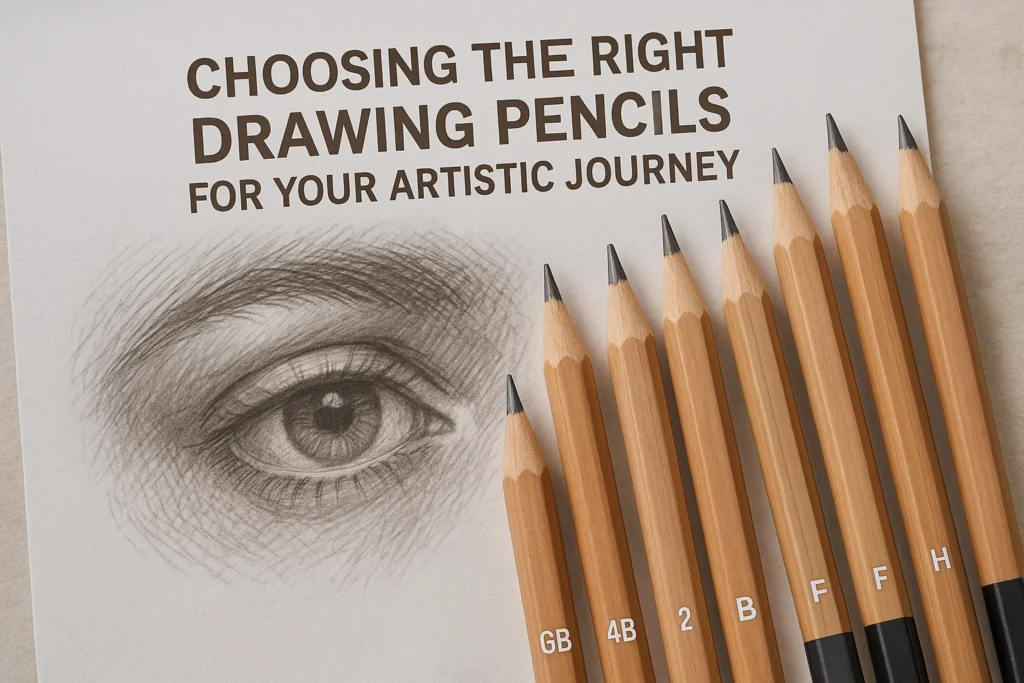
Your technique is improving, yet your lines still feel inconsistent. The issue may not be your hand, it may be your tools. Choosing the right pencils for drawing can elevate contrast, refine texture, and make shading more predictable. In this comparison guide, we will cut through marketing claims and focus on what matters to an intermediate artist who already understands fundamentals and wants more control.
You will learn how graphite grades behave across the H to B scale, and what that means for edge quality, sheen, and tonal range. We will compare wooden, mechanical, and clutch systems, including point retention, pressure sensitivity, and cost over time. You will see how core composition and binder content affect smoothness and smudge resistance. We will also weigh specialty options such as charcoal and carbon cores when you need deeper blacks, and how to pair them with the right paper.
By the end, you will know which sets to buy for sketching, rendering, and mixed media workflows, how to build a lean kit without gaps, and how sharpening methods influence mark making. Make your pencils work as precisely as you do.
Understanding Key Factors in Selecting Drawing Pencils
Graphite vs. colored pencils, and when each excels
For most pencils for drawing, the first decision is medium. Graphite gives clean value control, crisp linework, and easy erasing, which suits iterative sketching, tonal studies, portraits, and technical ideation. Colored pencils deliver saturated color, controlled layering, and glazing-like depth, ideal for botanical work, design renderings, and finished illustrations. Graphite is more forgiving and faster to revise; colored cores are less erasable and reward patient layering and burnishing. A practical split approach works well, for example, block forms and values in graphite, then commit color with oil or wax based colored pencils. See a concise comparison of working properties in Graphite vs. Colored Pencils: Understanding the Differences and When to Use Them.
Pencil hardness and its impact on sketches
Graphite hardness directly controls mark weight, texture, and shine. The full range spans 9H to 9B, with HB at the midpoint. Hard H grades carry more clay, print light, and hold a narrow point, which is useful for construction lines, hatching, and precise mapping. Soft B grades carry more graphite, lay down dark masses, and blend smoothly for expressive shading and atmospheric depth. For balanced kits, many intermediates rely on 2H for layout, HB or B for line refinement, and 2B to 6B for midtones to accents. Review the grading scale and use cases in Pencils, which hardness is perfect for you.
Durability, grip, and comfort
Consistent performance depends on construction. Look for well centered cores, bonded leads that resist breakage, and cedar or basswood casings that sharpen cleanly. Hexagonal or lightly matte coated barrels improve grip and reduce fatigue during long sessions; triangular barrels suit lighter pressure control. Softer cores benefit from thicker diameters to reduce snapping during heavy shading. Current ranges increasingly add break resistant leads, smoother laydown, and ergonomic grips, reflecting 2025 trends toward sustainability and user comfort.
Cost, availability, and matching to use
Graphite sets are widely available and budget friendly, which makes them efficient for high volume sketching. Artist grade colored pencils cost more due to pigment load and binder quality, so plan smaller curated palettes for detailed drawings. For quick sketches and studies, start with 2H, HB, 2B, and 6B. For detailed drawings, pair that graphite core with a limited color triad plus a colorless blender. In India, prioritize open stock availability so you can replace frequently used grades without buying entire sets. Next, we will compare practical pencil kits for different workflows and budgets.
Side-by-Side Comparison of Leading Drawing Pencil Brands
Pentel, Koh-i-Noor, and General’s at a glance
For precision-heavy sketching, Pentel’s Graph Gear line delivers reliable mechanics and control. The Graph Gear 500’s metallic mesh grip, 4 mm fixed sleeve, and refillable eraser make it a stable choice for hatching through rulers and templates, with 0.5 mm for linework and 0.7 mm for darker blocking Pentel Graph Gear 500 specifications. Koh-i-Noor’s 2 mm clutch systems, including tin-presented sets with integrated top-cap sharpeners, are versatile for quick switching between graphite and colored leads, which is useful for underdrawing and accents Koh‑i‑Noor Diamond Drawing Mechanical Pencil Set. General’s wood-cased Kimberly pencils offer dependable performance across studio-friendly grades, a good value for iterative studies and classroom use. Actionable tip: map construction with 2H to HB, build midtones with B to 2B, and reserve 4B to 6B for focal shadows, aligning to the common 9H to 9B graphite span used in pencils for drawing.
Staedtler Mars Lumograph vs Faber-Castell 9000
Staedtler Mars Lumograph covers an exceptionally wide range, often cited from 10H to 12B, giving specialists fine control from architectural lines to velvety blacks independent review of Lumograph grades. Hard grades feel notably smooth with minimal chatter, and the cores erase cleanly, which helps when layering technical hatching over tone. Faber-Castell 9000 typically spans 6H to 8B, balancing a crisp H range with rich B values that hold edges well during blending. Many artists find the 9000 slightly toothier in the H grades, which can improve bite on smoother papers, while 2B to 4B shine for portrait midtones. Practical choice: pick Lumograph for maximum grade breadth and ultra-hard drafting, choose 9000 for consistent tonal control in the core 6H to 8B studio band.
Specialty color, plus our curated picks for India
Faber-Castell Polychromos, an oil-based colored line, is praised for buttery laydown, high lightfastness, and a 120-color system that layers cleanly without wax bloom, ideal for display work and mixed-media overlays. With colored pencils and sustainability projected to lead 2025 to 2026 trends, consider refillable mechanics and responsibly sourced woods to align with eco goals while gaining ergonomic, break-resistant performance. At drawing-pencils.com, we curate precision mechanicals like Graph Gear, classic wood-cased studio sets in 6H to 8B, robust 2 mm clutch kits, and Polychromos assortments for gallery-grade color. Each range ships with grade-mapping guidance and paper pairing notes to help you move from clean layouts to confident finishes. This path ensures intermediate artists scale technique efficiently, without overbuying tools they will not use.
Benefits of Curated Drawing Kits: A Beginner’s Guide
What to expect in a solid first kit
A well-built starter kit covers tonal range, correction, and surface. Look for at least six graphite grades so you can move from clean construction lines to rich shadows. A mixed set that spans from hard to soft, ideally touching the 9H to 9B scale, gives you control over value and texture. See a mixed-grade graphite set example to understand how grades are bundled for versatility. Pair two erasers, a kneaded eraser for lifting highlights and a vinyl eraser for crisp corrections, with this core range; here is a concise kneaded and vinyl erasers overview. For paper, choose a medium-tooth, acid-free sketchbook around 80 to 100 gsm so pencils for drawing lay down cleanly and resist bleed; this acid-free sketchbook guidance shows what to look for. Blending stumps, a metal sharpener, and a soft brush round out a dependable beginner loadout.
Why pre-assembled kits accelerate early progress
Curated kits remove friction in three ways. First, they reduce trial-and-error spend by bundling proven, compatible tools. Second, they promote experimentation, since varied grades, blenders, and papers are ready on day one, which shortens the learning curve for hatching, layering, and edge control. Third, many modern kits reflect 2025 trends, prioritizing sustainable materials and high-quality leads with smoother laydown, break resistance, and ergonomic grips. Compared with building your own set, the main trade-off is fewer personalization options at first; the remedy is simple, choose a kit that states the exact grade spread and paper specs. For intermediate learners mentoring beginners, pre-assembled kits standardize materials, which makes feedback clearer and skill gains measurable.
What sets drawing-pencils.com kits apart, plus real results
Drawing-pencils.com kits are tuned for Indian classrooms and studios: calibrated graphite sets that cover essential grades, acid-free sketchbooks in humidity-stable weights, kneaded and vinyl erasers, blending tools, and a protective case that keeps points safe during delivery. Quick-start guides and skill-track checklists help novices practice values and edges in a sequenced way. Common myths do not hold up. Kits are not only for beginners, they are simply efficient. Quality does not suffer, our QC screens for point integrity and consistent tonal range. “In two weeks I moved from scratchy shading to clean gradients,” reports Aditi S., Pune. “The grade spread and paper choice ended my smudging problems,” adds Rahul M., Bengaluru. Recommendation: start with a six-grade graphite kit plus dual erasers; add colored pencils later if you plan mixed-media studies.
Balancing Quality and Cost: Finding Affordable Drawing Pencils
Price checkpoints and value tiers
For intermediate artists upgrading pencils for drawing, benchmark pricing helps set a smart budget. Faber-Castell 9000 open stock typically runs about 1.77 to 2.10 USD per grade, as listed for individual sticks on Faber-Castell 9000 individual pencils. Sets improve unit value; a 12-piece tin is approximately 22.17 USD, or about 1.85 USD per pencil, per the Faber-Castell 9000 12-piece set. Lyra Rembrandt open stock is around 1.90 USD, with the 12-piece set near 33 USD and the 24-piece set about 63 USD, shown in the Lyra Rembrandt pricing catalogue. This places 9000 as the stronger unit-value choice, while Rembrandt sits as a premium-priced alternative.
Lifespan versus cost: when paying more saves money
Pencil longevity is driven by core strength, graphite composition, and how aggressively you sharpen. Higher grade manufacturing yields denser, break-resistant cores that survive drops and pressure, which reduces waste over months of use. Smoother graphite also means fewer passes to reach target value, so you sharpen less and keep length longer. Expect soft grades like 4B to 6B to wear faster than HB to 2H, which stretches hard grades further per rupee. Over a semester, a slightly higher upfront price can be offset by fewer snapped tips and less sharpening loss.
Budget strategies for intermediate workflows
Buy a set for baseline grades, then top up your most used open-stock grades to avoid duplicates. Many intermediate artists rely on HB, 2B, 4B, and 6B for daily work; add 2H for clean construction and 8B for deep shadows. Use premium cores for finals and portfolio pages, and a secondary pencil for warmups and thumbnails. Track unit price, not just set price, to understand real value. Invest in a quality long-point sharpener and a kneaded eraser to extend pencil life and maintain edge fidelity.
Assessment of drawing-pencils.com’s affordable picks
Drawing-pencils.com’s curated range aligns with intermediate needs, offering grade coverage from 9H to 9B, student to artist tiers, and tins that balance cost and performance. Look for bundles that include the core HB to 6B ladder, because those grades handle most line, tone, and edge control tasks. Prioritize pencils marketed with break-resistant cores and smooth laydown, as these features lower long-term cost of use. Sustainability-labeled lines are increasingly available, matching 2025 trends without a steep premium. For most mid-level workflows, a 12-piece graphite tin plus two extra 2B and 6B sticks is a cost-effective, performance-first setup.
Traditional Pencils in the Digital Age: Why They Still Matter
Digital momentum, traditional value
Tablets offer layers, instant undo, and vast palettes, which accelerates iterations and delivery for client-facing work. Industry commentary on how digital tools are transforming traditional media highlights efficiency gains but also notes shifting attention away from tactile practices. Yet for pencils for drawing, fundamentals remain anchored in graphite’s graded control, from 9H for crisp construction to 9B for lush shading, a range that supports precise value design before color decisions. Current trends reinforce a continued role for analog, with colored pencils and sustainability set to dominate 2025 to 2026, while high quality cores add smoother laydown, break resistance, and ergonomic grips. Practical takeaway: pair digital for compositing and final color harmonies with pencil-based value studies to lock composition and lighting before committing to complex digital passes.
Why tactile pencils still win in key moments
Pencil on paper provides friction, audible feedback, and angle-based mark variation that deepen control over edge hierarchy and texture. Subtle wrist rotation shifts a 2B from hairline to velvety fill, and toothy papers amplify drybrush-like textures without plugins or brushes to configure. For spontaneity, a pocket set, H, HB, 2B, lands thumbnails in seconds, no charging, no latency, ideal for field studies or commuter sketch sessions. Exercises like five-step pressure scales and timed gesture sheets build muscle memory that carries into any medium. Recommendation: maintain a rapid ideation workflow on paper, then photograph and refine digitally only after the strongest thumbnails emerge.
What artists report, and how we support the practice
Many artists cite wooden pencils for their organic feel, from the meditative rhythm of sharpening to the intuitive modulation as the tip wears, while mechanical options trade feel for constant line width. Typical hybrid workflow: block values in HB, push accents with 4B, lift highlights with a kneaded eraser, then scan or capture in RAW and adjust levels for clean digital post. At drawing-pencils.com, we champion this analog core with curated kits by stage, grade charts and swatch downloads, and project-based tutorials that stress composition and value first. We feature sustainable picks, recycled woods and refillable formats, and ship across India with guidance tailored to intermediate goals. Community prompts and critique cycles keep traditional sketching central while integrating smoothly with digital delivery.
Conclusion: Making Your Choice Confidently
As you weigh pencils for drawing, revisit the criteria that matter in practice. Medium and grade determine control, with graphite spanning 9H to 9B for crisp construction through velvety shadows, and colored sets offering saturation and lightfastness for display work. Ergonomics and build affect fatigue and reliability, look for break resistant cores, smoother binders, and grips that fit your hand. A firm yet smooth HB blend is favored by many architects for crisp hatching and readable lineweights. Consider use cases, mechanical bodies excel at on location precision, while woodcase sets give wider tonal arcs and better expressive shading. Finally, align with current trends and values, colored pencils and sustainability are set to dominate 2025 to 2026, and premium lines increasingly use responsibly sourced wood and recyclable packaging.
Match the tool to the job. If you sketch portraits, keep 2H for mapping, HB or B for linework, and 4B to 6B for massing; on toned paper, add a white pencil for highlights. For field drawing and plans, a 0.5 mm mechanical with HB or B refills reduces sharpening downtime and maintains scale fidelity. Test systematically, run two 10 minute studies with different cores, rate line control, smudge resistance, eraser recovery, and tooth fill, then log the winner. Quality in artistry pays off, consistent cores break less, sharpen cleaner, and keep values predictable, which saves time across a project. When you are ready, explore curated pencils and kits, guidance, and fast delivery across India at drawing-pencils.com, and keep experimenting as your practice evolves.
