
Did you know that some of the world’s most famous masterpieces, from Renaissance sketches to modern portraits, began with a simple stick of charcoal? This ancient tool has been an artist’s trusted companion for centuries, capable of capturing light and shadow with an intensity that few other mediums can match.
We believe there’s a unique magic in this medium. As one contemporary painter noted, placing that first mark on paper feels serious and elemental. You are working with the most basic contrast: dark against light. This opens up a world of dramatic possibilities.
If you’re used to graphite, stepping into the world of charcoal drawing can feel like a revelation. Suddenly, you can achieve richer blacks, softer blends, and more expressive textures. It’s a journey we are excited to take with you.
This guide is designed for every artist, whether you are trying this for the first time or seeking to refine your skills. We will walk you through selecting materials and mastering techniques used by professionals. Our goal is to give you the confidence to create your own compelling artworks.
Key Takeaways
- Charcoal is a timeless artistic medium known for its deep blacks and dramatic contrast.
- Transitioning from graphite to charcoal unlocks new possibilities for texture and expression.
- This guide is tailored for artists of all skill levels, from absolute beginners to experienced practitioners.
- You will learn how to select the right tools and master fundamental and advanced techniques.
- The ultimate goal is to empower you to create lifelike and emotionally resonant artwork.
Introduction to Realistic Charcoal Pencil Drawing
The journey into charcoal artistry begins with understanding how this remarkable medium transforms simple marks into powerful visual statements. We define this approach as artwork created primarily with charcoal applied to paper surfaces. The material’s versatility shines through its various forms and hardness levels, each suited to different artistic approaches.
What makes charcoal stand out is its incredible range of expression. You can move from bold, dynamic strokes to delicate, quiet passages within a single composition. This flexibility allows for truly personal artistic statements that capture both observation and emotion.
The powdery nature of charcoal creates unique opportunities for blending and smudging. Even with just your fingers, you can achieve soft transitions and atmospheric effects. This tactile quality establishes an immediate connection between artist and artwork that feels both ancient and contemporary.
For many creators, transitioning from basic school pencils to charcoal represents a significant evolution. Suddenly, those deep, rich blacks you’ve admired in other works become achievable. This opens up entirely new creative possibilities for capturing light, shadow, and texture.
Ultimately, working with charcoal isn’t just about making marks on paper. It’s about finding that perfect balance between what you see and what you feel. This medium helps translate experiences into artwork that resonates with emotional truth and visual impact.
Gathering the Right Materials for Charcoal Drawing
Before your first mark touches the surface, thoughtful material selection sets the stage for your creative journey. We believe the right tools empower your artistic expression and help you achieve the results you envision.
Choosing the Best Charcoal Types
Different charcoal forms serve distinct purposes in your artwork. Willow and vine varieties offer lighter, more erasable marks ideal for initial sketches.
Compressed options provide deeper, richer blacks for bold statements and final details. Each type brings unique qualities to your creative process.
Essential Tools and Supplies
A kneaded eraser is indispensable for both correction and creative effects. This versatile tool lifts pigment to create highlights and refine shadows with precision.
Blending stumps allow you to manipulate texture without finger smudges. Keep various sizes on hand for different blending needs.
We recommend multiple erasers in your toolkit. Include both kneaded and vinyl types for different correction techniques. A utility knife gives you control when sharpening your charcoal pencils.
Quality paper with appropriate tooth completes your setup. The right surface holds pigment effectively while allowing smooth blending transitions.
Understanding Different Types of Charcoal
The true versatility of this medium reveals itself when we explore the distinct properties of compressed and Powdered charcoal forms. These specialized options offer unique advantages for different stages of your creative process.
Compressed and Powdered Options
Compressed charcoal starts as powdered charcoal mixed with a gum binder. This mixture gets pressed into round or square sticks. The hardness depends on the binder amount. This is the same material found inside charcoal pencils.
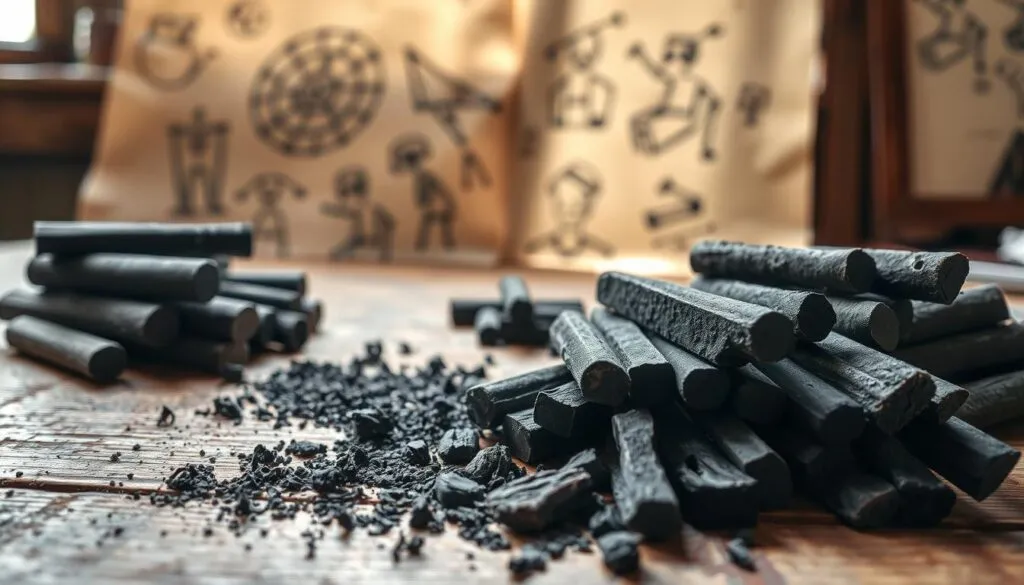
Because Compressed charcoal holds a sharp point well, it’s perfect for fine details and dark accents. It creates crisp edges that give your artwork strong visual impact. This type of drawing charcoal expands your tonal range significantly.
Powdered charcoal offers a completely different approach. In its fine powder form, it’s ideal for soft, subtle layering. You can quickly cover large areas of your surface with light, even tones.
Applying powdered charcoal requires tools like paintbrushes or cloth. This method feels more like painting than traditional drawing. It creates wonderfully smooth, atmospheric effects across your working surface.
I’ve been using charcoal powder with a broad brush to establish larger areas more loosely. This technique feels fun and very painterly—though admittedly very messy. The brush keeps edges soft and creates lively, natural value transitions.
While powdered charcoal comes in containers and can be expensive, its unique advantages justify the investment. You establish broad tonal areas, then use erasers to lift charcoal for highlights. This lets you pull light from darkness creatively.
Preparing Your Paper and Work Environment
Creating an optimal environment for your artistic process can dramatically improve your charcoal drawing experience. We believe the right setup empowers your creative flow and prevents common frustrations.
Selecting the Right Paper Texture
The paper you choose significantly impacts your final results. Different textures create unique effects with charcoal materials.
Heavier papers with substantial tooth hold pigment effectively. They allow for multiple layers without compromising the surface. Lighter papers work well for quick sketches and studies.
Over time, we’ve found that medium-textured papers offer the best balance. They provide enough grip for dark applications while allowing smooth blending.
| Paper Type | Tooth Level | Best For | Weight Recommendation |
|---|---|---|---|
| Rough Texture | High | Bold, expressive marks | 140-300gsm |
| Medium Texture | Moderate | Versatile applications | 120-180gsm |
| Smooth Surface | Low | Fine details | 100-150gsm |
Setting Up a Well-Lit Workstation
Proper lighting is essential for charcoal work. These artworks naturally feature dark values that require clear visibility.
We recommend positioning your easel near natural light sources. Artificial lighting should mimic daylight conditions. This approach helps you see subtle value transitions accurately.
Working vertically at an easel prevents accidental smudging. It also encourages stepping back to assess your composition. Keep all tools within easy reach to maintain creative momentum.
Remember that charcoal can be messy. Cover your work area and keep cleaning supplies handy. This simple preparation makes the creative process more enjoyable.
Fundamental Techniques to Begin Your Artwork
Every successful artwork shares a common starting point: identifying and sketching the essential geometric shapes that build its framework. We believe this approach creates a solid foundation for all your creative work.
Sketching Basic Shapes and Outlines
Hold your charcoal pencil just like a regular graphite pencil to achieve sharp edges and well-defined lines. This grip ensures maximum control, letting only the point contact the paper surface.
Begin by lightly outlining basic geometric forms. Everything you’ll ever draw can be broken down into circles, squares, triangles, and cylinders. This method prevents getting lost in details too early.
We recommend sketching the entire figure or scene before moving to individual elements. Apply more pressure for darker lines to mark important structural boundaries and areas of contrast.
In technical terms, this foundational approach dramatically improves accuracy. Your initial marks aren’t meant to be perfect—work loosely to capture essential gestures and proportions.
As you practice these techniques, you’ll find that creating drawings becomes more intuitive. The simple act of shape identification builds confidence for all your artistic endeavors.
Exploring Advanced Charcoal Techniques
The magic of advanced charcoal work lies in learning to work in reverse, pulling light from darkness. We guide you through methods that transform your approach from additive to subtractive creation.
Blending and Smudging Methods
Beyond basic application, blending tools create atmospheric effects. We recommend using stumps and cloths for controlled transitions.
These methods soften harsh edges and build dimensional forms. The right pressure creates everything from subtle gradients to bold contrasts.
Utilizing Kneaded Erasers for Highlights
A kneaded eraser becomes your most versatile tool for creating light. Shape it into points for precise work or broad surfaces for larger areas.
These special erasers lift pigment to reveal the paper beneath. You literally pull highlights from shadow, building dramatic contrast.
Be sensitive to the direction light moves across your form. This awareness makes your highlights feel natural and dimensional.
We occasionally supplement with charcoal-specific erasers for sharper effects. Different kneaded erasers offer varying levels of control for detailed work.
| Eraser Type | Best For | Control Level | Finish Quality |
|---|---|---|---|
| Kneaded Eraser | Soft highlights, blending | High | Natural, gradual |
| Charcoal Eraser | Sharp highlights, corrections | Medium | Crisp, defined |
| Drafting Eraser | Bright whites, final touches | Low | Clean, stark |
This subtractive approach often produces more powerful visual results. Establish rich darks first, then strategically reveal your highlights.
Step-by-Step Process for a Realistic Charcoal Pencil Drawing
The final stage of your artwork brings together all the techniques we’ve explored into a cohesive whole. This is where your initial sketch transforms into a fully dimensional creation.
Blocking in Light and Dark Values
We recommend regularly stepping back to reassess your darkest areas. Freshly intensify shadows where needed to maintain strong visual impact.
Use compressed charcoal for broad, rich passages. Well-sharpened drawing charcoal handles finer details beautifully. This combination creates powerful contrast.
Developing Texture and Contrast
Every type of implement contributes to your final charcoal drawings. Blend light masses and mid-tones using varied tools for interesting texture.
Diffuse edges strategically with paper stumps or gentle finger blending. Each tool creates unique effects that enhance your artwork’s richness.
Work primarily with kneaded erasers to pull out final highlights. This subtractive method often produces more natural-looking light effects.
For textured areas like grass, establish a broad tone first. Then carefully erase into it to create lighter elements. Finally, accent darks with various tools for maximum dimension.
As you complete your work, ensure you’ve achieved a full value range. The interplay between different elements makes your subject feel tangible and alive.
Incorporating Lighting and Shadows
The true drama in your artwork emerges when you master the interplay of light and shadow. This stage transforms a flat image into a dimensional scene. We guide you through the techniques that bring your subjects to life.
Effective management of highlights requires foresight. Your lightest areas often come from the untouched paper. It is paramount to plan your design early, treating these bright spaces as sacred.
Once darker values are established, a kneaded eraser becomes your primary tool. You pull light from the shadows. Artist Julio Reyes used this method for the tall grasses in “Stars Above,” first laying a broad tone then carefully erasing to reveal light.
Creating Dramatic Contrasts
The sense of illumination itself comes from the contrast between your darkest darks and brightest lights. This relationship is the core of visual impact. Intentional restraint here often yields more powerful results than adding white media.
Managing Highlight Areas
Consider how light behaves on different surfaces. A sharp reflection needs a crisp, preserved edge. A soft glow on fabric may allow for gentle erasing. Your understanding of the light source guides this entire work.
Remember, once an area of your surface is darkened with charcoal, returning it to pure white is challenging. This is why we stress preserving highlights from the start. This careful approach will empower your creations with stunning luminosity.
Tips for Refining and Finishing Your Artwork
Finishing touches on your artwork reveal the unique fingerprint of your creative vision. This phase transforms technical skill into personal expression.
We embrace Julio Reyes’ insight that completion involves wisdom beyond technique. Your work evolves through dedicated time, presenting challenges only you can resolve.
Final Touches and Detail Enhancement
As you apply details with your charcoal pencil, remember this drawing becomes more than an image. It captures your experiences and creative journey.
Those final marks represent your artistic signature. They show your hand and heart to viewers. You’ll know your drawings are complete when they feel alive with presence.
We strongly recommend using fixative to protect your artwork. This spray holds charcoal particles securely in place.
Fixative comes in two types: workable and final. Many artists prefer workable fixative for flexibility. It allows small adjustments after application.
Apply fixative in a ventilated area. Hold the can 12 inches from your surface. Use light, even coats with drying time between applications.
In artistic terms, proper finishing ensures your creation endures. This careful approach preserves all your hard work for years to come.
Drawing Inspirations from Master Artists
Learning from artistic masters provides invaluable shortcuts to developing your own creative vision and technical skills. We encourage studying both historical and contemporary approaches to expand your creative toolkit.
Insights from Julio Reyes
Contemporary artists like Julio Reyes demonstrate how traditional methods remain relevant. His approach emphasizes continuous assessment throughout the creative process.
Simple techniques like squinting at your work reveal basic light and dark shapes. This helps assess value relationships without detail distraction.
Adapting Techniques from Art Tutorials
Viewing your piece in a mirror spots structural errors effectively. It also reveals negative shapes previously unnoticed.
Studying famous works provides diverse perspectives. Van Gogh’s “A Zandmennik house” and Degas’ “Portrait of an Italian” show different approaches to the same medium.
| Assessment Technique | Primary Benefit | When to Use | Skill Level |
|---|---|---|---|
| Squinting at Work | Simplifies value relationships | Throughout process | All levels |
| Mirror Viewing | Reveals compositional errors | Mid to late stages | Intermediate+ |
| Distance Viewing | Assesses overall balance | Final stages | All levels |
| Upside Down Viewing | Breaks familiarity bias | Any stage | Advanced |
These methods work on any surface type, including watercolor paper. Remember they’re flexible tools, not rigid rules. Adapt them to discover what serves your artistic voice best.
Conclusion
As we bring this comprehensive guide to a close, remember that mastery emerges from consistent practice and joyful experimentation. We’ve equipped you with the essential techniques and insights to create artwork that captures both visual accuracy and emotional resonance.
In artistic terms, becoming proficient with this medium requires dedicated time and patient exploration. Each piece you create teaches you something new about how materials respond to your touch. Embrace the learning process as part of your growth as an artist.
We encourage you to continue developing your skills with confidence. Your unique creative voice will shine through as you apply these methods. Remember that every drawing represents progress on your artistic journey.
FAQ
What are the main types of charcoal I should start with?
How do I prevent my artwork from smudging?
What is the best way to create highlights in a charcoal piece?
Can I use regular paper for charcoal, or do I need a specific kind?
What is a blending stump used for?
How can I add more depth and realism to my drawings?
