

If your lines feel inconsistent, the problem may not be your technique. It may be your tools. Choosing the right professional artist drawing pencils is a practical skill, and it separates confident, repeatable results from guesswork. As an intermediate artist you already understand pressure control, layering, and edge quality. Now it is time to match those skills with pencils that deliver predictable tone, clean transitions, and reliable point retention.
In this comparison, you will learn how core composition and clay ratio affect smoothness, feedback, and break resistance. You will see how graphite grades translate to usable tonal range on common papers, and why some sets excel at crisp line work while others shine in velvety shading. We will compare leading ranges such as Faber Castell 9000, Staedtler Mars Lumograph, Mitsubishi Hi Uni, Tombow Mono, and Caran d’Ache Grafwood. Expect guidance on smudge control, sharpening behavior, batch consistency, and cost per usable tone. You will also get clear recommendations by workflow, sketching speed, detail rendering, mixed media, and studio or field use. By the end, you can choose with intention, not habit, and build a pencil lineup that supports your best work.
Comparison Criteria: What to Consider
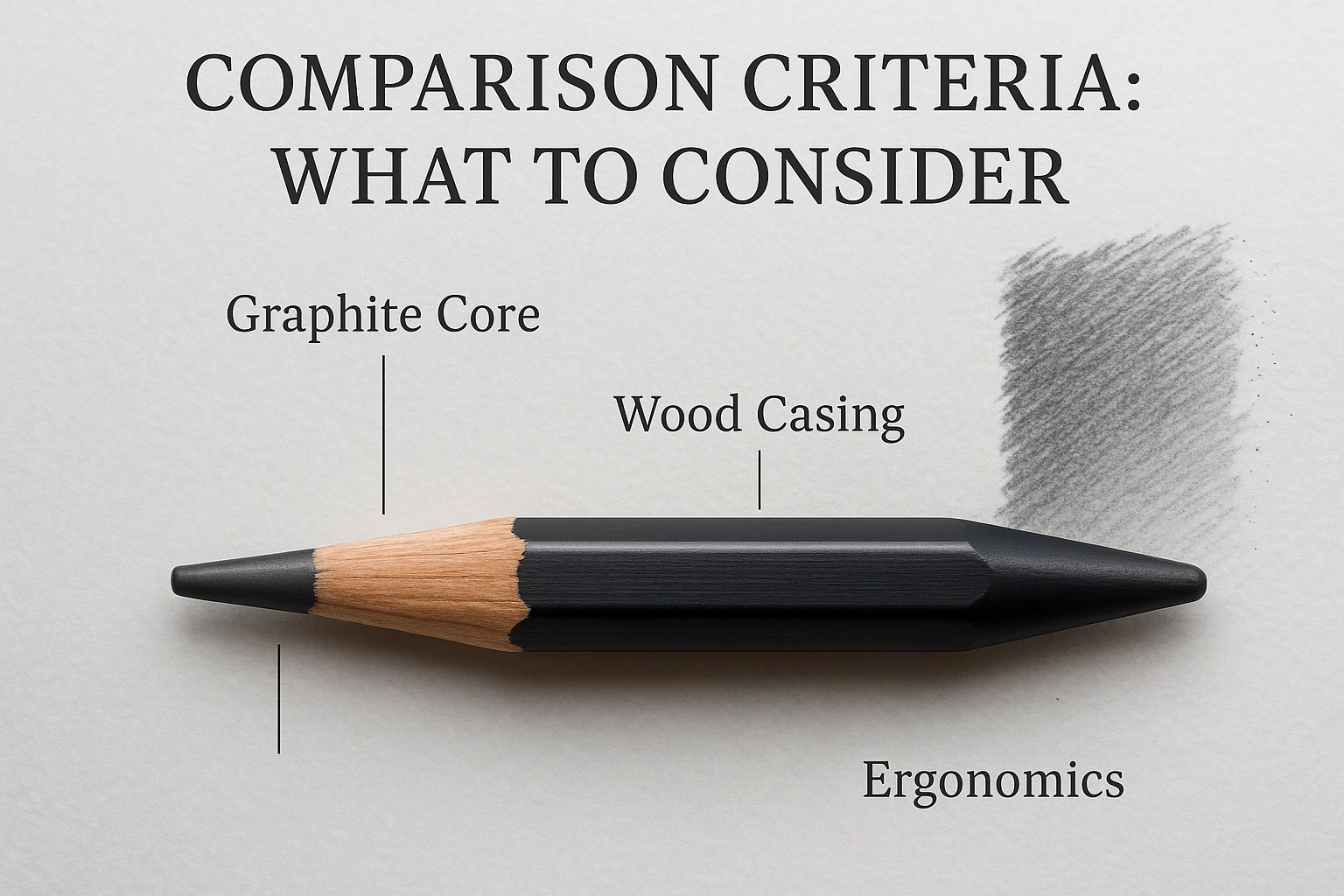
Essential features that matter for professional artist drawing pencils
For reliable mark-making, evaluate the graphite core, wood casing, and ergonomics together. Consistent, well-milled graphite yields smooth gradients with minimal scratchiness and less dust, which helps when layering tones. Cores typically range from about 2 to 3.5 mm; thinner cores favor precision line work, while thicker cores deposit richer tone for shading. Look for centered cores and bonded leads, these reduce breakage during sharpening and drops. The wood should sharpen cleanly without splintering, cedar and high-grade basswood are common, and a matte, hex or semi-hex barrel improves grip control during long sessions.
How to compare: texture, durability, flexibility
Texture determines how a pencil lays down on toothy versus smooth papers. Test a 0 to 100 percent graphite gradient and a 1 cm cross-hatch square, you want even coverage, clean edges, and predictable blending. Independent 2025 evaluations highlight smoothness and consistency as top performance factors, see the best graphite pencils guide. Durability shows up in two places, point retention and break resistance. Perform a sharpen test, sharpen three times, draw firm hatching, then inspect for tip crumbling. Product spec pages that detail core bonding and casing quality can help you shortlist options, review typical features on artist graphite pencils specifications. Flexibility is the range of tones and line widths a pencil can produce; test overhand and tripod grips, vary pressure from feather-light to firm to confirm tonal reach without glazing.
Premium quality, sustainability, and grade choices
Premium pencils should be non-toxic with clear conformity markings, ASTM D-4236 or EN71, water-based varnishes, and responsibly sourced or recycled wood. Bio-based or recycled-wood options reduce environmental impact without sacrificing performance, see this bio-based pencils overview. With a reported 12 percent rise in basic art supply costs, stretch your budget by buying open stock for heavy-use grades and sets for range; in India, professional singles often start near ₹75 per pencil. For grades, H to 2H excels at clean construction lines, HB to 2B balances detail and midtones, 4B to 8B delivers deep shadows and expressive strokes. A practical trio for most sketches is 2H, HB, and 4B, add 6B when you need velvety blacks and stronger contrast. Transition to the next section with your shortlist in hand, then match sets or open-stock choices to your subject matter and paper.
Analyzing a Range of Options
Selecting professional artist drawing pencils is a balance of performance, technique, and budget. With a reported 12 percent rise in basic art supply prices, intermediate artists in India are seeking tools that deliver durability and predictable results without overspending. Colored pencil buyers increasingly favor sustainable, premium cores for longevity and archival quality, while graphite users look for full hardness ranges for tonal control. It helps to map tools to use cases, for example colored layers for glazing and graphite for structure, then build a kit that supports those tasks. Below is a concise analysis to guide smart, stage‑appropriate choices.
Popular artist-grade options
Faber-Castell Polychromos stand out among colored pencils for their oil-based cores, strong lightfast ratings, and 3.8 mm break‑resistant leads, as detailed in this overview of the line being recognized as a category leader, see Polychromos awarded Best Colored Pencil. For graphite, Staedtler Mars Lumograph provides a wide 12B to 10H spectrum that supports both deep shading and crisp technical lines, see this independent roundup of top drawing pencils. Mechanical options like the LAMY Safari are valued for ergonomic grips and consistent line weight, helpful for construction lines and repeated detailing. Kohinoor Hardtmuth’s charcoal and graphite offerings add expressive, matte blacks ideal for value studies and accent shadows.
Faber-Castell Polychromos, pros and cons
Pros include excellent lightfastness across most of the range, reliable point retention for detail, and smooth, controlled layering that resists wax bloom. The harder oil core supports clean edges and fine hatching, and the bonded lead reduces breakage during sharpening. Cons are primarily the premium price and the slightly higher effort needed to achieve buttery blends compared to softer cores. Actionable tip, use light pressure layering, then burnish selected passages, and reserve a few colors for solvent blending to speed coverage.
How drawing-pencils.com fits within the spectrum
Our curation focuses on technique-based bundles and budget steps. Entry graphite trios around common market pricing starting near ₹75 per pencil help build tonal skill, while full-range graphite sets suit value rendering. For color, we prioritize open‑stock Polychromos for affordable replenishment and compact 12‑color foundations for layered work. Pair a 0.5 mm mechanical pencil with 2H leads for layout, add HB, 2B, and 6B for form, and include a small set of artist‑grade colors and a soft charcoal stick for punchy shadows. This modular approach keeps costs manageable, aligns tools to tasks, and supports growth across your creative journey.
Understanding Pencil Grades and Uses
The graphite grade scale at a glance
Professional artist drawing pencils are graded by core hardness from 9H, hardest, to 9B, softest, with HB and F in the middle. H grades contain more binder, so they cut cleaner lines, feel crisp on toothy paper, and print light values that erase cleanly. B grades carry more graphite, so they glide smoothly, build dark masses quickly, and excel at expressive mark making. HB is the universal workhorse for layout and general sketching, while F maintains a slightly finer point for controlled hatching. Think of H for structure and mapping, HB for block-in, and B for volume, atmosphere, and final impact.
How grades translate to shading and detail
Hard cores, 2H to 5H, favor hairline precision, minimal smudge, and repeatable line weight, ideal when you need clean cross-contour or perspective mechanics. They can, however, score the paper if overpressured, which makes later blending harder. Soft cores, 2B to 8B, deposit more material, enabling buttery gradients, rich occlusion shadows, and convincing edge transitions. The tradeoff is higher smudge risk and faster tip wear, so controlled pressure and frequent rotation are essential. Pair hard grades with smooth papers for drafting clarity, and soft grades with medium-tooth sheets for richer graphite pickup.
Match grades to your style
For technical illustration and architectural linework, build a triad of 3H, H, and F for construction, refinement, and final line. Urban sketchers benefit from HB for gesture, 2B for midtone push, and 4B for focal accents, compact and quick to sharpen. Portrait artists often rely on H for light mapping, B and 2B for skin transitions, and 6B or 8B for hair depth and pupil contrast. Landscapes respond well to 2H for distant structure, HB and 2B for local value groups, and 5B for foreground punch. In short, H grades reduce noise, B grades add drama; combine them to control edges and value hierarchy.
Versatile kits that simplify choices
If you want range without overbuying, start with a 12-piece H to 8B set for full tonal coverage and consistent feel across grades. For travel or classroom use, a five-pencil capsule, 2H, HB, 2B, 4B, 6B, covers layout, modeling, and deep shadow with minimal weight. Mixed kits that include a kneaded eraser, vinyl eraser, sharpener, blending stumps, and a sandpaper pad enhance control and extend pencil life. At drawing-pencils.com, look for curated kits labeled by workflow, such as Draft to Detail or Sketch to Shade, so you can align selections to your process. This approach keeps your toolkit purposeful, cost efficient, and ready for both precision and expressive work.
Sustainability and Quality Trends
Materials are shifting toward lower-impact choices
Across professional artist drawing pencils, material choices are evolving toward recycled and responsibly sourced inputs. Recycled-wood, bamboo, and paper-cased pencils reduce pressure on virgin timber, a move validated by guides to eco-friendly pencil materials. Many artists now look for FSC labels that signal responsible forestry, a practice highlighted in roundups of sustainable art supplies, including FSC-certified wood. Another option is woodless graphite, which delivers a higher percentage of usable core per stick and less sharpening waste, as seen in contemporary woodless artist pencils. For Indian buyers balancing climate and cost, these choices allow a measurable reduction in waste and packaging without sacrificing core performance.
Quality pays for itself
Premium pencils typically offer stronger cores, better bonding with the casing, and tighter grade tolerances, which translate into fewer breaks, cleaner edges, and predictable value sketches. In a year that saw a 12 percent rise in basic art supply prices, durability and consistency help offset upfront costs through longer service life and fewer replacements. Artists report cleaner erasing and reduced smudging with high-grade graphite, which preserves paper surface and accelerates iteration. Even when a market listing shows pencils at around ₹75 per piece, higher-end options can deliver a lower cost per finished study because fewer strokes are lost to crumbling points or inconsistent hardness. For intermediate artists, this means smoother hatching across H to B grades and repeatable results in mixed-media workflows.
How sustainability shapes buying decisions, and our approach
Purchase decisions increasingly weigh ethics alongside performance, especially for studio restocks and teaching kits. Many artists now prioritize transparent sourcing, recyclable packaging, and waste-minimizing formats like woodless graphite, provided tonal control and lead uniformity remain excellent. At drawing-pencils.com, we curate sets with responsibly sourced woods and recycled or minimal-plastic packaging, consolidate shipments to cut transport impact, and perform quality checks that reduce returns and waste. We label sustainability attributes clearly so you can compare eco profile, grade range, and break resistance side by side. Practical tip, shortlist two options per need, for example wood-cased FSC vs woodless graphite, then test for point retention, erase quality, and value scales before committing to a full set.
Building Your Perfect Pencil Collection
Start with intent: build a kit that mirrors your technique
Begin by mapping your most frequent subjects and methods, then assemble your core. If you draw architecture or fine line studies, prioritize harder grades for edge fidelity and a mechanical pencil for consistent 0.5 or 0.7 mm lines. For portraits and tonal studies, invest in softer cores for deep values and smooth gradients. Open stock lets you choose exactly what you use, though per-pencil cost can be higher, while curated kits bundle essentials and accessories at better value, a smart move given the 12 percent rise in basic supply prices. A pragmatic starter spine for professional artist drawing pencils is 4H, 2H, HB, F, 2B, 4B, 6B, and 8B, plus a kneaded eraser, a vinyl eraser, a two-step sharpener, and blending stumps. For reference-grade consistency across grades, a mixed set like the Palomino Graphite Mixed Grade Drawing Pencil Set offers a clean baseline for testing.
Balance your grades and colors for range and control
Think in ranges. Graphite handles structure and value; charcoal supplies expressive, matte blacks; colored pencils add temperature, glazing, and selective emphasis. Compare options: wood-cased graphite is versatile and clean, woodless 6B covers large areas quickly, mechanical pencils reduce sharpening downtime. For color, start with 24 essential hues, include warm and cool primaries, three earths, two neutrals, two grays, and a high-coverage white. Oil-based colored pencils layer thin and sharp for details; wax-based formulas build faster coverage but can bloom if overworked. Charcoal pencils in soft, medium, and hard, plus a white charcoal, expand dynamic range on toned paper. If you want an all-in-one springboard, a comprehensive set such as the Deluxe 101-Piece Sketch & Colored Pencil Art Kit consolidates tools into a portable workflow.
From intermediate to pro: refine, test, and organize with drawing-pencils.com
Intermediate artists should build swatch charts, a nine-step value scale, and a blending test on their preferred paper to confirm grade spacing. Professionals often add a precision eraser, a sandpaper block for custom points, and a roll-up case to protect cores on location. To manage budgets in India where single pencils can sit near ₹75 each, combine open-stock refills for high-use grades with bundle sets for breadth. At drawing-pencils.com, curated filters by grade, medium, and format simplify selection, while starter, intermediate, and studio bundles present balanced ranges that align to use cases like urban sketching, portraiture, or product rendering. Product guidance, clear specs, and reliable delivery help you upgrade intentionally, so your collection evolves with your technique rather than your drawer filling with duplicates.
Recommendations and Conclusion
Summary and key comparisons
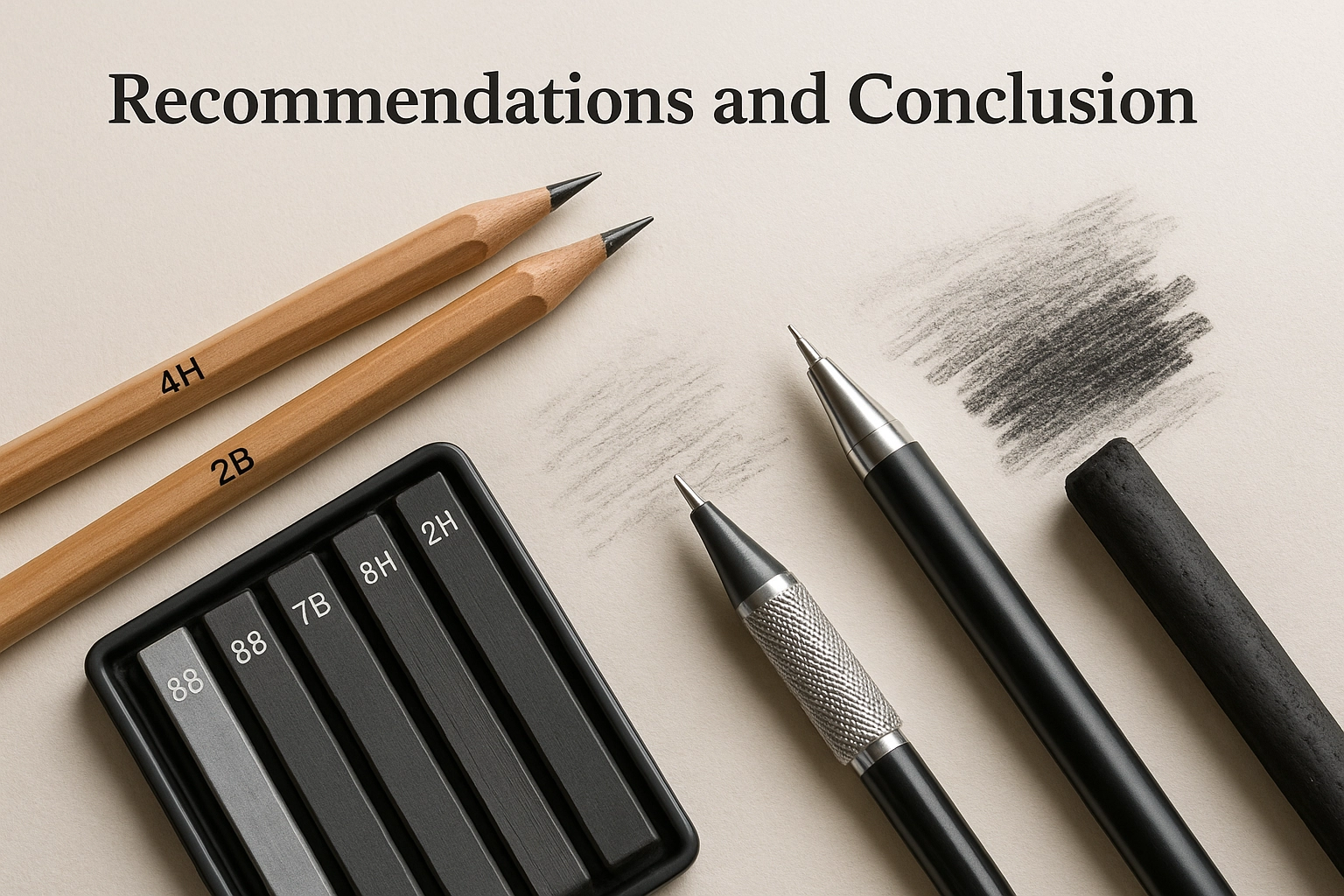
Across professional artist drawing pencils, graphite sets remain the most versatile, with H grades delivering crisp line control and B grades offering smooth, expressive shading. Mechanical options excel for repeatable precision and clean hatching, while charcoal adds unmatched deep values and atmospheric blacks, although it smudges more and needs fixative. Pre-bundled kits improve value when prices are rising, a 12 percent increase was reported for basic supplies, yet single pencils let you target the grades you actually use. For budgeting in India, expect roughly ₹75 per pencil as a baseline, so a focused 8 to 10 pencil core often outperforms a scattered, larger assortment. Sustainability is gaining ground, so look for responsibly sourced wood casings and refillable leads to reduce waste and long-term cost.
Recommendations and next steps
For an intermediate workflow, assemble a core of 4H, 2H, F, HB, B, 2B, 4B, 6B, plus one 8B for rich darks, add a kneaded eraser, blending stumps, and one soft charcoal pencil for punchy shadows. Pair this with a 0.5 mm mechanical pencil for construction lines and fine architectural details. If you prefer an all-in-one starting point, review an 110 piece sketching kit example, then refine with individual upgrades using a charcoal and graphite pencils reference. Explore drawing-pencils.com for curated sets, step-by-step guidance, and reliable delivery across India, tailored to your stage. Commit to quality, maintain a lean kit you fully master, and let consistent practice transform good tools into great drawings.
